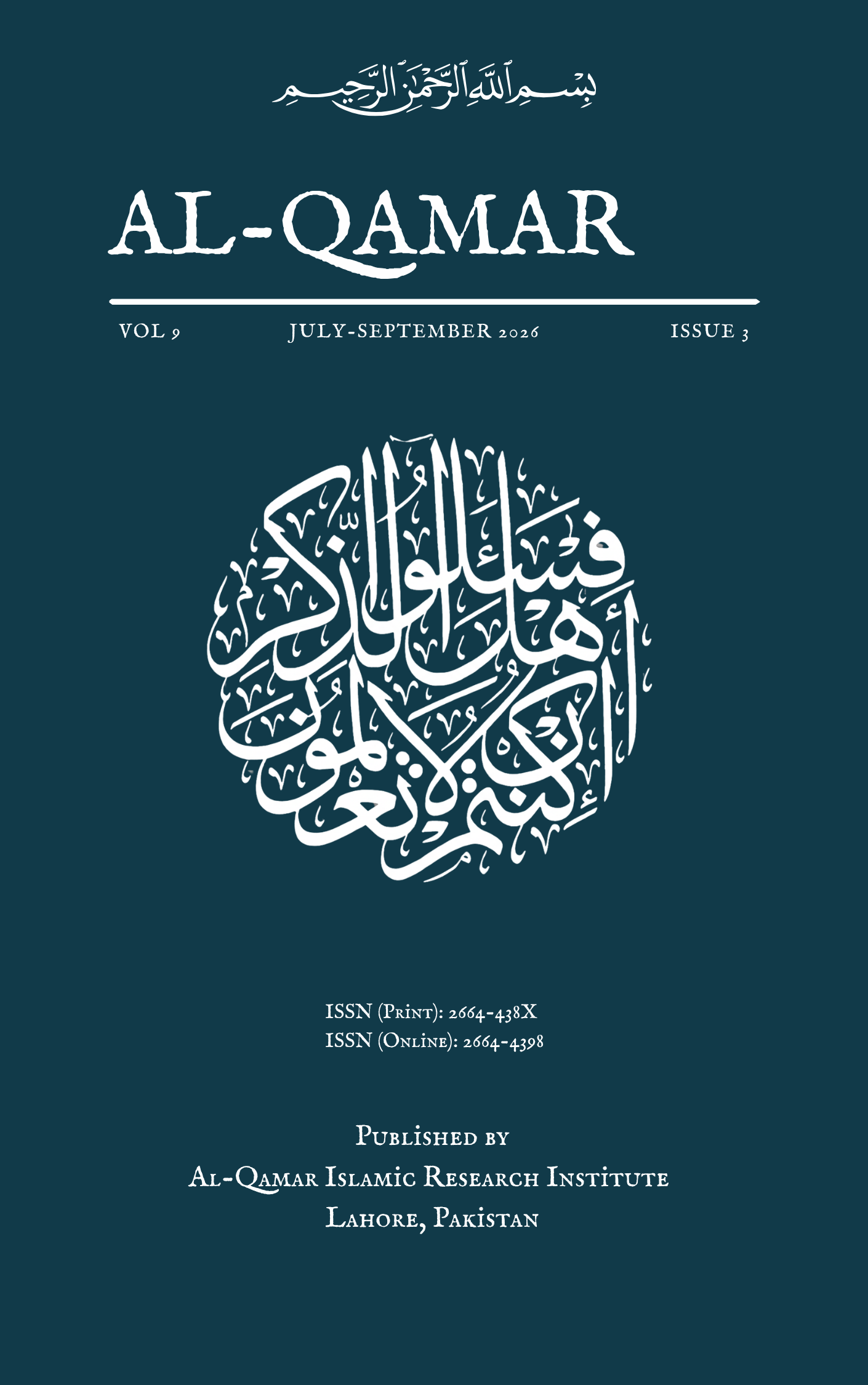
About the Journal
ISSN (Print): 2664-438X
ISSN (Online): 2664-4398
Published by: Al-Qamar Islamic Research Institute, Lahore, Pakistan
Published Since: 2017
Frequency: Quarterly (4 issues per year)
Languages: English | Urdu | Arabic
Publication Mode: Print & Online
HEC Pakistan Category: Y
Acceptance Rate: 22%
Published Articles: 1100+
Submission: Via OJS System
Peer Review: Double-Blind
About Research Journal Al-Qamar
Research Journal Al-Qamar, Lahore is a quarterly, double-blind peer-reviewed, open access academic journal published by Al-Qamar Islamic Research Institute, an independent research institute dedicated to the promotion of quality scholarship in Islamic Studies and related fields of knowledge. The journal has been established to provide a credible scholarly platform for researchers, teachers, postgraduate scholars, and academic institutions working in the areas of Islamic learning, humanities, social sciences, religious studies, law, ethics, education, history, civilization, and contemporary Muslim thought.
The journal is among the early scholarly journals in Pakistan established and managed by an independent research organization rather than a university. Its first issue was published in 2017 after two years of rigorous academic planning, editorial development, policy formation, and institutional preparation. Since its beginning, the journal has worked to build a serious research culture by encouraging original, well-documented, ethically responsible, and academically valuable research.
Research Journal Al-Qamar follows a clear academic mission: to promote research that connects classical Islamic scholarship with contemporary intellectual, legal, social, educational, and ethical questions. The journal welcomes studies that engage with Islamic textual traditions, historical sources, modern scholarship, social realities, and emerging debates affecting Muslim societies in Pakistan and the wider world. It is committed to strengthening academic dialogue among scholars of different linguistic, regional, and intellectual backgrounds.
Scholarly Scope
The journal is multidisciplinary in scope and covers major areas of Islamic learning and allied disciplines. Its areas of interest include Qurʾānic Studies, Ḥadīth Studies, Sīrah Studies, Fiqh and Islamic Law, Uṣūl al-Fiqh, Islamic jurisprudence, Islamic history, Muslim civilization, Sufism, philosophy, theology, Islamic ethics, Islamic education, interfaith studies, comparative religion, Orientalism, Muslim reform movements, Islamic modernism, contemporary Islamic thought, and issues related to Muslim societies.
The journal also welcomes research that connects Islamic Studies with the humanities and social sciences. Studies related to law, education, sociology, history, political thought, culture, peace studies, religious harmony, intellectual history, manuscript studies, textual analysis, and contemporary social challenges may be considered where they fall within the journal’s academic focus. This broad scope allows Research Journal Al-Qamar to support both classical scholarship and contemporary research-based discussion.
Journal Sections
Research Journal Al-Qamar publishes scholarly content in four main sections: Research Papers, Review Essays, Scholarly Commentary, and Monographs. Research Papers include original academic articles based on proper research methodology, critical analysis, and clear contribution to knowledge. Review Essays provide critical evaluation of books, scholarly trends, academic debates, intellectual traditions, and emerging areas of research.
Scholarly Commentary provides space for serious, evidence-based, and academically responsible reflection on contemporary intellectual, religious, legal, ethical, social, and educational questions. It is not casual opinion writing; rather, it is a form of informed academic intervention that clarifies debates, responds to issues, and contributes to responsible scholarly dialogue. Monographs are extended scholarly works that deal with a topic in greater depth than a regular article, including long-form research studies, textual studies, critical editions, translations with scholarly introduction, and comprehensive thematic investigations.
Peer Review and Quality Assurance
The journal follows a strict double-blind peer review process. In this process, the identities of authors and reviewers are kept confidential to ensure fairness, impartiality, and academic objectivity. Every submitted manuscript is first examined by the editorial office for relevance, originality, formatting, completeness, plagiarism concerns, and suitability within the journal’s scope.
Manuscripts that pass the initial editorial screening may be sent to qualified reviewers with relevant subject expertise. Reviewers evaluate the manuscript on the basis of originality, academic contribution, methodology, structure, argument, use of sources, language quality, citation accuracy, and relevance to the field. The editorial board may accept, reject, or request minor or major revisions after considering reviewer comments and editorial assessment.
Ethical Code and Publication Integrity
Research Journal Al-Qamar is committed to ethical scholarly publishing. The journal expects all authors, reviewers, editors, and editorial board members to follow principles of honesty, transparency, originality, confidentiality, fairness, and academic responsibility. The journal does not support plagiarism, duplicate publication, false authorship, fake references, fabricated data, manipulated citations, undisclosed conflicts of interest, or any form of publication malpractice.
Authors are responsible for the originality, accuracy, legality, and ethical integrity of their manuscripts. Reviewers are expected to provide fair, confidential, and constructive evaluation. Editors are responsible for maintaining academic standards, protecting the review process, and making decisions based on scholarly merit rather than personal, institutional, financial, or ideological pressure.
Plagiarism Detection and Original Content
The journal publishes only original scholarly work. Submitted manuscripts are checked for originality through editorial review and plagiarism detection procedures. Authors must properly cite all sources, quotations, ideas, translations, data, and arguments taken from other works. Self-plagiarism, duplicate submission, and recycling of previously published material without proper acknowledgement are not acceptable.
A manuscript may be rejected if it contains excessive similarity, unattributed material, fabricated references, unreliable sources, or unethical reuse of previously published content. If plagiarism or serious academic misconduct is discovered after publication, the journal may issue a correction, expression of concern, or retraction according to the nature of the case.
Digital Identifiers, ORCID iD, and Metadata
Research Journal Al-Qamar supports the use of digital identifiers and structured metadata to improve discoverability, citation, indexing, and long-term accessibility of published research. Where applicable, article-level digital identifiers such as DOI may be used to provide stable identification and permanent linking of scholarly content. The journal encourages authors to provide accurate names, institutional affiliations, emails, and ORCID iD where available.
Accurate metadata is essential for scholarly visibility. The journal maintains article-level metadata including title, author information, abstract, keywords, references, publication date, volume, issue, pages, DOI where applicable, language, and licensing details. Proper metadata supports indexing services, search engines, academic databases, library systems, citation tools, and digital preservation mechanisms.
Interoperability and Digital Formats
The journal supports interoperability through structured publishing practices, metadata management, indexing readiness, digital identifiers, and standardized article formats. Its publication system may support multiple formats including PDF, HTML, and XML-JATS where available or technically possible. These formats help readers, databases, libraries, and indexing agencies access, preserve, and process published content more effectively.
PDF format provides a stable reading and citation version, HTML improves online readability and accessibility, while XML-JATS supports structured scholarly publishing, machine readability, metadata harvesting, and compatibility with modern academic databases. The journal’s commitment to interoperability reflects its aim to enhance academic visibility and long-term usability of published research.
Digital Preservation and Long-Term Access
Research Journal Al-Qamar is committed to preserving its scholarly record. The journal maintains online archives of published volumes, issues, article pages, PDFs, metadata, and editorial records. Digital preservation is necessary to ensure that published research remains accessible to future scholars, libraries, institutions, and researchers.
The journal may use website backups, database backups, article file storage, metadata records, OJS archiving functions, DOI records, institutional storage, and external indexing channels where applicable. In the case of website migration, platform update, or technical change, the journal makes reasonable efforts to preserve published files, abstracts, metadata, DOI links, issue archives, and author records.
Research Data Policy
Authors are expected to maintain accurate records of research data, sources, manuscripts, interviews, field notes, archival documents, references, translations, tables, and other research material used in their studies. Where necessary, authors may be asked to provide supporting data for editorial verification, especially in cases involving ethical concerns, disputed claims, or questions of authenticity.
Research data must be handled responsibly. Authors must respect privacy, consent, copyright, confidentiality, institutional rules, religious sensitivity, cultural context, and legal limitations. Research involving human participants, interviews, surveys, institutions, or sensitive communities should follow appropriate ethical standards and, where required, informed consent procedures.
Languages of Publication
Research Journal Al-Qamar accepts manuscripts in English, Urdu, and Arabic. This multilingual policy reflects the journal’s commitment to promoting academic dialogue among diverse scholarly communities. Authors writing in any of these languages must ensure clarity, accuracy, proper academic style, and consistency in citations and terminology.
Research in Islamic Studies often requires engagement with Arabic, Urdu, Persian, English, and other scholarly traditions. Therefore, the journal encourages careful translation, transliteration, and citation of classical and modern sources. Authors are responsible for the correctness of Qurʾānic references, Ḥadīth references, Arabic terms, translated passages, and bibliographic details.
Publisher: Al-Qamar Islamic Research Institute, Lahore, Pakistan
Journal Type: Quarterly, Double-Blind Peer-Reviewed, Open Access Academic Journal
Major Fields: Islamic Studies, Humanities, Religious Studies, Law, Ethics, Education, History, and Muslim Societies
Languages: English, Urdu, and Arabic
Formats: PDF, HTML, XML-JATS where available
Author Responsibility
Authors submitting to Research Journal Al-Qamar are requested to carefully review the journal’s aims and scope, author guidelines, submission requirements, reference style, publication ethics, plagiarism policy, research data policy, and copyright or licensing terms before submission. Submission to the journal means that the author accepts the editorial process and agrees to cooperate with the editorial office during review, revision, proofing, and publication.
The journal reserves the right to return incomplete submissions, request revisions, seek clarifications, check references, verify authorship, ask for ethical statements, or reject manuscripts that do not meet academic, ethical, or technical standards. The final decision regarding acceptance, rejection, revision, correction, or withdrawal rests with the editorial authority of the journal.